Physical AI & multimodal

Multimodal annotation for systems that perceive, decide and act.

Physical AI supervision must connect what happened, when it happened and what the system did next. Grasp designs human-verified datasets across camera, depth, LiDAR, robot state, action, language and outcome.

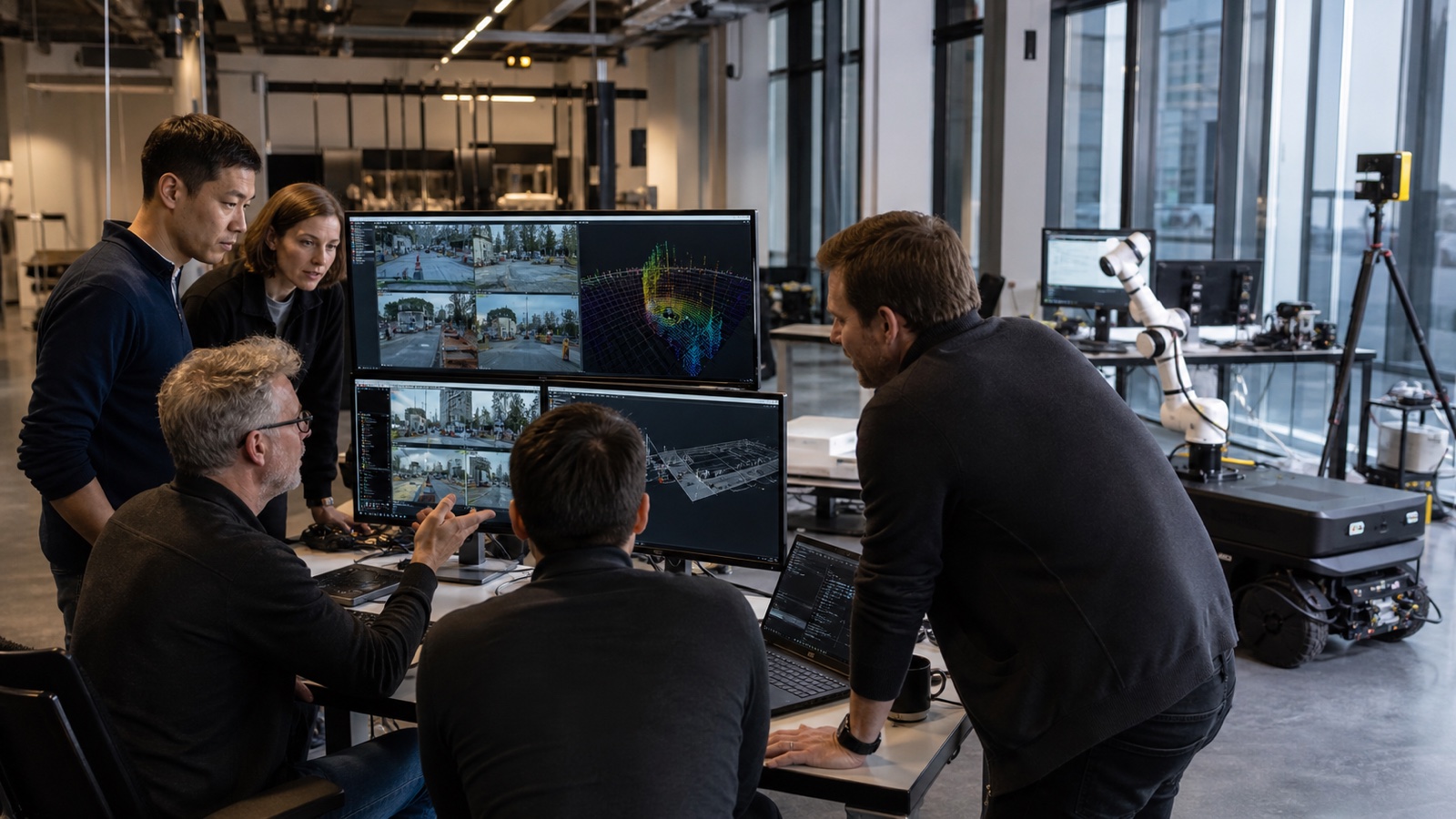
Automotive and robotics leaders reviewing camera and sensor data beside a mobile robot in a working lab

Where programs get difficult

The hard part is rarely drawing the first label.

Time alignment

Small clock offsets can turn correct labels into incorrect supervision across sensors and actions.

Cross-modal meaning

An event may be visible in one stream, measurable in another and only understandable from both.

Context preservation

Flattening episodes into independent samples can erase intent, causality and delayed outcomes.

Changing systems

Ontologies and acceptance criteria must evolve without losing comparability across dataset versions.

What we deliver

Ground truth built for the system around it.

  • Cross-sensor temporal alignment and event labels
  • Vision, depth, point-cloud and state annotation
  • Action, intent and outcome supervision
  • Multimodal evaluation and rubric-led review
  • Failure taxonomies and hard-case collections
  • Traceable dataset versions and acceptance evidence

Quality controls

  • Synchronization checks before semantic annotation
  • Calibration examples spanning ordinary and difficult cases
  • Independent review at cross-modal decision points
  • Documented ontology changes and backward-compatibility decisions
  • Risk-based sampling tied to model and operational failure modes

From ambiguity to production

Prove the workflow before adding volume.

01

Map the decision

Identify what the system must perceive, predict, evaluate or do—and which signals provide evidence.

02

Design the schema

Connect entities, time, state, action, language and outcome without flattening away useful context.

03

Prove on real data

Use a calibration set to expose synchronization errors, ambiguity and missing sensor context.

04

Scale deliberately

Expand trained teams and review effort around the risks and distributions the pilot revealed.

Design the ground truth around the decision—not the file format.

Show us the signals you collect and the behavior you need to improve. We’ll design a representative pilot that preserves the context your system depends on.

Request a pilot plan